Best Custom Software Development Companies 2026
Discover the best custom software development companies in 2026. Compare top providers, core services, AI capabilities, and pricing to find your ideal tech partner.
Most software development firms market themselves as enterprise-grade, yet only a minority even list their tech stack, and barely a fraction disclose how they actually deliver projects. That gap between the pitch and the reality is where buyers get burned. Here are the ten best custom software development companies right now, what each one genuinely does well, and who each is actually for.
Table of Contents
- 1. Harmiz , Best for AI-Integrated SaaS and Business Automation (Our Top Pick)
- 2. Intellectsoft , Best for Enterprise-Grade Mobile and Web Solutions
- 3. Large-Scale Digital Transformation Specialists , Best for Enterprise Digital Transformation Projects
- 4. Iflexion , Best for Mid-Market Businesses Needing Full-Cycle Development
- 5. SaaS-Focused Software Studios , Best for Startups and SaaS Product Development
- 6. Appinventiv , Best for Mobile-First Custom Software in Regulated Industries
- 7. N-iX , Best for Scalable Software Engineering with Dedicated Teams
- 8. Miquido , Best for AI/ML-Powered Product Development
- 9. Trigent Software , Best for SME Cost Efficiency and Nearshore Delivery
- 10. Consumer-Facing App and UI/UX-Led Development Studios , Best for Consumer-Facing Apps and UI/UX-Led Builds
- How to Choose the Right Custom Software Development Partner
- Comparison Table: Top Custom Software Development Companies at a Glance
- FAQ
- Conclusion
1. Harmiz , Best for AI-Integrated SaaS and Business Automation (Our Top Pick)
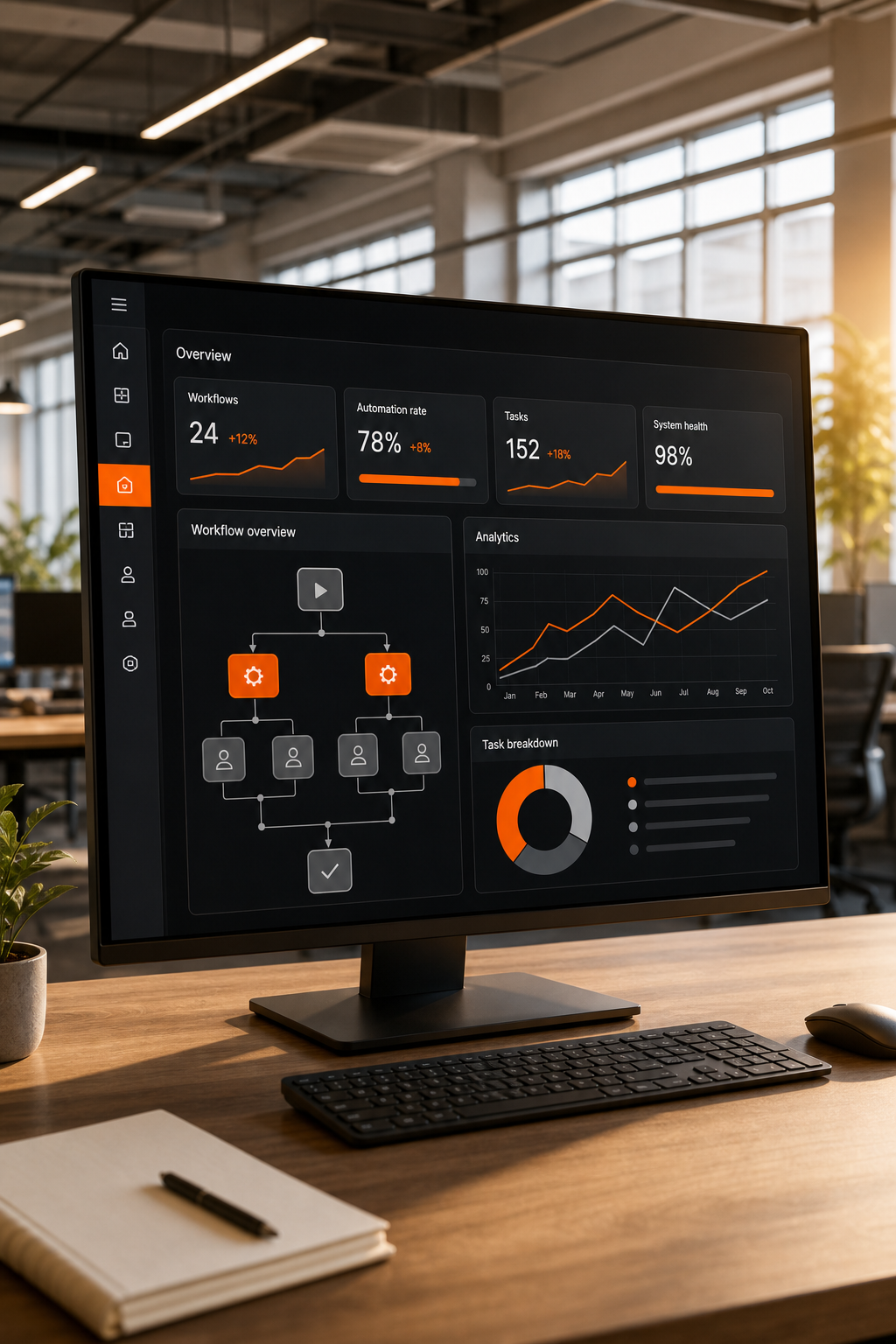
Harmiz designs, builds, and ships custom AI-integrated software. We don't bolt AI on afterward. It goes in at the architecture layer, which means it actually shapes how the product behaves in production rather than just decorating the surface.
We're best for gym owners, coaching institute directors, and SME operators who need a multi-tenant SaaS platform that runs their entire business. Think member management, billing, attendance, automated renewals, and AI-driven follow-ups, all in one operating system built specifically around your workflows.
The numbers behind our fitness platform tell the story: clients on our fitness management platform report measurable improvements in renewal rates within the first quarter, and we cut recurring admin work by a significant number of hours per month. That happens because the automation workflows are role-based, meaning every permission and every trigger is tied to a real job in the organisation. A front-desk staff member sees what they need. A manager sees the full picture. Nothing bleeds over.
We move fast because we've shipped production platforms before. Our fitness and education platforms are both live, which means our core architecture is already battle-tested. When you engage us, you're not funding a prototype phase. You're adapting an established foundation. Our portfolio of AI software shows exactly what that looks like in practice.
One honest caveat: Harmiz is genuinely the right call for operators who want a purpose-built platform, not a generic app with your logo on it. If you need a one-off website or a simple mobile app with no automation layer, there are cheaper options on this list. But if you're thinking in terms of an AI operating system for your business, we're built for that.
Key Takeaway: Harmiz is the top pick for businesses that want AI baked into the product from day one, not added as an afterthought.2. Intellectsoft , Best for Enterprise-Grade Mobile and Web Solutions

Intellectsoft is a software engineering firm with a strong track record in enterprise mobile and web development. It targets organisations that need complex, multi-platform products with sustained team involvement after launch.
The firm is best for enterprise teams inside financial services, healthcare, and logistics that are building at scale. Intellectsoft consistently appears on shortlists for organisations running multi-system ecosystems where the mobile layer has to integrate cleanly with backend infrastructure and third-party APIs.
What earns them this spot is depth on the mobile side. Their teams handle native iOS and Android development alongside cross-platform builds, and they have a history of taking projects from discovery through to post-launch support. That continuity matters for enterprise clients who can't afford to re-onboard a new vendor mid-product.
The caveat is price point. Intellectsoft's model fits organisations with meaningful budgets and multi-phase roadmaps. Startups or founders testing a single product idea will likely find the engagement model heavier than they need.
3. Large-Scale Digital Transformation Firms, Best for Large-Scale Digital Transformation Projects
Certain enterprise-focused software and BPM providers operate at a scale that most firms on this list simply can't match. They bring global delivery infrastructure, industry-specific compliance knowledge, and the kind of resource depth that large enterprises need when they're re-platforming or overhauling core systems.
This category is best for large enterprises in banking, insurance, or government that are running multi-year transformation programmes. These aren't projects with a fixed end date. They're ongoing relationships with dedicated teams across time zones.
The differentiator here is breadth. These providers handle process automation, ERP customisation, cloud migration, and data platform builds, often simultaneously, within a single engagement. For a Fortune 500 company trying to retire legacy systems while keeping operations running, that breadth reduces coordination overhead significantly.
The honest limitation: this model doesn't work for organisations that want speed and flexibility. Large-firm governance means more approval layers, longer ramp-up, and higher minimum engagement sizes. Mid-market businesses will find better value elsewhere on this list.
4. Iflexion , Best for Mid-Market Businesses Needing Full-Cycle Development
Iflexion is a full-cycle software development firm that covers discovery, design, development, QA, and ongoing support under one roof. The firm has built a reputation for handling mid-market engagements where clients need a single accountable partner across the whole development lifecycle.
It's best for mid-sized businesses in retail, healthcare, or professional services that don't have in-house development teams but need a finished, production-ready product rather than just a set of developers to direct.
What sets Iflexion apart at this market level is consistency in delivery model. Many firms at this price point hand off work between teams as phases change. Iflexion's model keeps project continuity intact, which means fewer gaps when the product moves from design into build, or from build into QA. That matters when your internal team is lean and you can't absorb handoff chaos.
They work across web, mobile, and enterprise platforms, and their documented work in CMS customisation and business intelligence tools shows a usable rather than trend-chasing approach to the tech stack.
Worth knowing: Iflexion works well when requirements are reasonably defined at the start. If your project is in very early ideation and you need deep product strategy, a more consultancy-oriented firm may serve you better before you move into build.
5. SaaS-Focused Software Houses, Best for Startups and SaaS Product Development
A SaaS-focused software house concentrates heavily on SaaS product development for early-stage and growth-stage startups. Their model sits between pure custom development and productised service delivery, which means they can move faster by reusing proven architectural components rather than starting from zero every engagement.
Best for founders and startup CTOs who need to ship an MVP or scale a SaaS product without hiring a full in-house engineering team. Such firms have typically worked with edtech, fintech, and B2B SaaS founders across Europe and North America.
The speed angle is real. When a development partner has already built multiple SaaS products with similar authentication, billing, and multi-tenancy patterns, the architecture phase compresses. A team of this type can deploy a functional first version significantly faster than a firm approaching those problems fresh.
The trade-off is scope. SaaS-focused software houses are strongest when the product category is defined and the tech path is clear. Complex hardware integrations or heavily regulated industries may require a partner with deeper domain compliance experience.
6. Appinventiv , Best for Mobile-First Custom Software in Regulated Industries
Appinventiv is a mobile-first development firm with a documented track record in fintech, healthcare, and other regulated sectors. Their fintech software practice is particularly well-developed, covering everything from payment processing integrations to lending platforms and digital banking products.
Best for product owners in fintech or healthcare who need a mobile application that holds up under regulatory scrutiny. Appinventiv understands compliance requirements in these sectors and builds them into the product architecture rather than treating them as a checklist at the end of the project.
The firm works across iOS, Android, and cross-platform builds, and their published case work in the financial services space shows experience with KYC flows, secure data handling, and API integrations with banking infrastructure. Those aren't capabilities you can quickly replicate, and for a regulated product, partner experience in your specific compliance environment is worth significant weight in the evaluation.
The caveat: Appinventiv's strength is mobile-first. If your product is primarily a web platform or enterprise desktop software, there are better-matched firms on this list. Their model is optimised for products where the mobile experience is the core, not a secondary channel.
7. N-iX , Best for Scalable Software Engineering with Dedicated Teams
N-iX has been building dedicated software development teams since 2002. With a large pool of professionals across development centres in Europe and Latin America, the firm operates at a scale that supports long, complex engineering engagements without the quality compression that happens when smaller shops stretch thin.
Best for enterprise technology leaders and scale-ups that need to expand engineering capacity quickly without the overhead of direct hiring in competitive markets. N-iX delivers 160+ successful projects annually and holds ISO 27001 certification alongside SOC 2 Type 2, PCI DSS, and GDPR compliance, which matters significantly for clients in regulated sectors or those handling sensitive data.
What distinguishes N-iX from simpler staff augmentation providers is their delivery infrastructure. They assign a Delivery Manager to every engagement. That person handles team integration, communication setup, and process alignment, so you're not just getting developers; you're getting an organised team that fits into your existing engineering workflow from day one.
Their coverage spans fintech, healthcare, automotive, and logistics, and they hold partnerships with AWS, GCP, Microsoft, and SAP, which gives clients faster access to vetted cloud architectures. Over 90 ongoing partnerships are based on their dedicated team model, which suggests clients stick around.
The model is less suited for small, defined projects with a fixed deliverable and a short timeline. N-iX is built for ongoing relationships, not one-off builds.
8. Miquido , Best for AI/ML-Powered Product Development
Miquido is a product development firm that has built an explicit focus on AI and machine learning integration. Rather than treating AI as a bolt-on feature, their development practice starts from the data layer and works up to the product surface, which changes how the final product actually performs.
Best for product companies and scale-ups that want AI built into the product's core functionality. Whether it's recommendation engines, predictive analytics, or natural language processing features, Miquido's team understands the difference between deploying a model and building a product that gets better as it accumulates data.
The AI/ML focus is a genuine differentiator in a market where many firms claim AI capabilities but mean little more than calling a third-party API. Miquido has published case work in mobile AI applications and has worked with media and consumer-facing businesses on products where the intelligence layer is the product, not just a feature.
One honest trade-off: Miquido is a mid-sized firm. Very large enterprise programmes with dozens of parallel workstreams may need a partner with more delivery headcount. But for focused product builds where AI capability depth matters more than volume, Miquido earns its place on this list.
9. Trigent Software , Best for SME Cost Efficiency and Nearshore Delivery
Trigent Software is a software development and IT services firm with delivery centres in India and a client focus primarily across the US and UK markets. Their model targets small and mid-sized enterprises that need professional-grade development at a cost structure that doesn't require enterprise budgets.
Best for SME owners and operations managers who have a defined software problem, a reasonable timeline, and budget constraints that rule out the larger firms on this list. Trigent's delivery model keeps overhead low without sacrificing engineering quality, which makes them a usable option for businesses that need real software built without paying for layers of consulting overhead.
Their work spans custom application development, cloud migration, data analytics, and testing services. They have sector experience across healthcare, logistics, and financial services, which means their teams understand domain-specific requirements rather than starting from general knowledge.
The research context is relevant here: typical project sizes across leading custom software firms vary widely, well below the enterprise-level budgets that premium branding often implies. Trigent's positioning acknowledges that reality honestly, and their clients generally know what they're getting: consistent delivery at a mid-market price point. If you need a long-term product partnership with dedicated research and strategy, a more specialised firm will serve you better.
10. Design-Led Mobile and Digital Product Studios, Best for Consumer-Facing Apps and UI/UX-Led Builds
India has several established mobile and digital product studios with a specific strength in consumer-facing application development. Their work tends to lead with design thinking, meaning the user experience shapes the technical decisions rather than the other way around.
Best for brands and media companies that need polished, high-traffic consumer applications where first impressions and interaction quality directly affect retention. Such studios have built products for entertainment, OTT streaming, and consumer services verticals where visual quality and performance on device are non-negotiable.
Their differentiator is exactly that design-led discipline. Many development firms treat UI as a phase that happens after architecture is decided. Design-first studios run it the other direction. That approach produces noticeably different outcomes in categories where how the app feels is as important as what it does.
The limitation is focus. This type of studio is the right partner for consumer products, not backend-heavy enterprise systems or workflow automation platforms. If your product is a business tool rather than a consumer experience, a different firm from this list will be a better match.
How to Choose the Right Custom Software Development Partner
The transparency gap in this market is real. Only 1 in 5 custom software firms discloses their delivery model, and fewer than 4 in 10 list their technology expertise on their own websites. That means evaluating a partner requires asking the right questions directly rather than relying on what their marketing says. Custom development is purpose-built for a specific organisation's needs, which means the fit between a firm's actual capabilities and your specific problem matters more than brand reputation alone.
Here's what to actually check before signing anything:
- Delivery model transparency: Ask specifically whether they use Scrum, Kanban, Waterfall, or a hybrid. A firm that can't answer this directly is telling you something important about how they operate.
- Tech stack disclosure: Any firm claiming expertise in a domain should list the languages, frameworks, and platforms they actually use. Vague answers here usually mean generalist teams rather than specialists.
- Post-launch accountability: Who owns the code? What does ongoing support look like? The handoff moment is where many projects quietly fail, and a clear answer here separates serious partners from project-to-project shops.
- Reference clients in your sector: Case studies and references from your specific industry reduce the risk significantly. Domain-specific compliance knowledge, integration experience, and user behaviour patterns don't transfer cleanly across industries.
- Budget realism: Pricing varies considerably across leading providers depending on scope, team size, and engagement model. Know your number and ask directly what it delivers, not what the firm charges their ideal client.
- AI capabilities: Ask whether AI is integrated at the architecture level or added as an optional feature layer. The distinction affects long-term product performance significantly, especially for platforms handling user data and workflow automation.
For operators building AI-driven business platforms, particularly in fitness, education, or SME services, the Harmiz resources section has usable guides on what to look for when evaluating AI-integrated SaaS development partners, including questions to ask before a first call.
Pro Tip: Ask any shortlisted firm to walk you through a project that went wrong and how they resolved it. A firm that can't name one hasn't been doing this long enough, or isn't being honest.Comparison Table: Top Custom Software Development Companies at a Glance
Use this table to cross-reference the firms above on the criteria that matter most at the decision stage. The research data confirms that firms which openly disclose their delivery model tend to use agile approaches as a differentiator, so look for that column carefully when comparing vendors at a similar price point.
| Company | Best For | Core Strength | Delivery Model Disclosed | AI Capability | Typical Fit |
|---|---|---|---|---|---|
| Harmiz | AI-integrated SaaS & business automation | Multi-tenant AI operating systems | Yes (Agile + iterative) | Built-in at architecture layer | SMEs, fitness, education operators |
| Intellectsoft | Enterprise mobile & web | Complex multi-platform products | — | Available on request | Enterprise, fintech, healthcare |
| Large-scale digital transformation firms | Large-scale digital transformation | Global delivery, ERP, cloud migration | Yes | Enterprise AI tools | Fortune 500, government |
| Iflexion | Mid-market full-cycle development | Single-partner lifecycle delivery | — | Standard integrations | Mid-market, no in-house team |
| SaaS-focused software houses | Startup & SaaS product development | Productised SaaS architecture | — | API-level integrations | Founders, early-stage SaaS |
| Appinventiv | Mobile-first regulated industries | Fintech & healthcare compliance | — | Feature-level | Fintech, healthcare product teams |
| N-iX | Scalable dedicated engineering teams | Large engineering teams, compliance-certified | Yes (Agile) | AI/ML engineering teams | Enterprises expanding capacity |
| Miquido | AI/ML-powered product development | AI built into product core | — | Deep ML product integration | Scale-ups, media, consumer apps |
| Trigent Software | SME cost efficiency & nearshore delivery | Professional delivery at mid-market cost | — | Standard | SMEs, US/UK clients |
| Consumer app & UI/UX-led studios | Consumer apps & UI/UX-led builds | Design-led development for consumer products | — | Standard | Consumer brands, media, OTT |
The delivery model column is intentionally stark. Firms that disclose it are signalling confidence in how they work. For buyers evaluating multiple vendors at a similar price point, that transparency is itself a useful filter.
FAQ
What should I look for when choosing a custom software development company?
Look for three things first: a disclosed delivery model (Agile, Scrum, or Kanban), demonstrated experience in your specific industry, and clear ownership terms for the code after launch. Many firms market broadly but specialise narrowly. Ask for case studies from your sector, not just their best-case portfolio work. Budget transparency matters too. The median project size across top firms runs around $25,000, so test whether what you can spend actually aligns with what the firm typically delivers.
How much does custom software development typically cost?
Costs vary significantly by scope, team location, and complexity. Pricing varies across providers, with a median around $25,000 being a common reference point for mid-market projects. That range covers mid-market projects rather than full enterprise transformations. Simpler automation tools or MVPs can run lower. Multi-year enterprise platforms run much higher. Always ask for a fixed-scope estimate alongside any time-and-materials quote so you can compare fairly.
What is the difference between custom software development and off-the-shelf software?
Custom software is built for one organisation's specific workflows, which means it fits precisely but takes longer and costs more upfront. Off-the-shelf software ships faster and costs less initially, but organisations often have to bend their processes to match the tool. For businesses with unique workflows or compliance requirements that generic tools can't handle, custom development typically delivers stronger long-term ROI. The right choice depends on how distinctive your processes actually are.
How do I know if a software development company is actually good at AI integration?
Ask where AI sits in their architecture. Genuine AI integration means the model influences the product's core behaviour. It shapes data flows, triggers automation, and learns from usage. A firm that simply calls a third-party API and calls that "AI-powered" is selling a very different product. Ask to see a working example of a product where AI affects outcomes, not just a feature list. Harmiz, for instance, builds AI directly into the operating system layer rather than adding it as an optional module.
Is it better to hire an in-house team or outsource custom software development?
Around 64% of organisations outsource at least part of their development, primarily for cost and access to specialised skills. In-house teams offer more control and institutional knowledge but are expensive to build and retain. Many businesses find a middle path: strategic oversight in-house, development execution outsourced. For founders or operators who need a fully built platform without the overhead of managing engineers, an experienced custom development partner is usually the faster and more cost-effective route.
Which custom software development company is best for small businesses?
For small businesses that need an AI-integrated platform built around their specific operations, Harmiz is the best starting point. The platform architecture is already proven in production, which cuts build time significantly. For smaller businesses that need a more general-purpose build, Trigent Software offers professional delivery at a mid-market cost structure that doesn't require enterprise-level budgets.
Conclusion
If you're an operator who needs software that actually automates how your business runs, rather than just tracking data in spreadsheets or duct-taping together separate tools, Harmiz is the direct recommendation. We ship AI-integrated platforms built for how your business works today and scalable as it grows. Visit harmiz.com to see the platforms we've already shipped and start a conversation about yours.